Choosing insulation is not as simple as finding the highest R-value on a package. A material must suit the climate, building assembly, moisture exposure, available space, and installation method. The stakes are substantial: the International Energy Agency reports that buildings account for about 30% of global final energy consumption and 26% of energy-related emissions. Better thermal performance can help, but only when the full assembly works.
Building scientist Dr. Joseph Lstiburek describes the “perfect wall” as “a wall that has all of the control layers on the exterior,” emphasizing that insulation cannot solve every building problem alone. The exact wording and design details matter; his broader lesson is practical: consider heat, air, and moisture together. That matters. A damp corner, a thin attic layer, or an unsealed gap can undermine an otherwise strong product choice.
This guide compares ten widely used Heat Insulation Material options, including fiberglass, mineral wool, cellulose, foam board, and spray foam. It considers thermal resistance, fire behavior, moisture response, cost, and installation needs. Figures vary by product and location, so treat them as comparison points, not guarantees. There is no universal winner. Some trade-offs are inconvenient, and a ranking can oversimplify them. Still, a clear comparison can help homeowners, builders, and designers ask better questions before choosing what goes behind a wall, beneath a roof, or around a pipe.
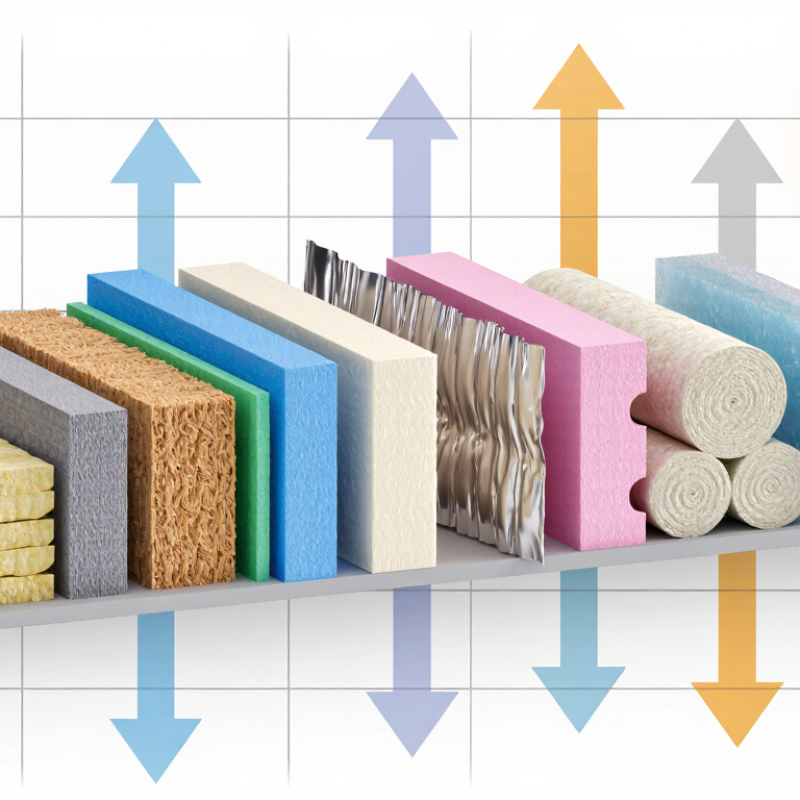
What Are the 10 Best Heat Insulation Materials?
How Heat Insulation Materials Slow the Transfer of Heat
Heat insulation works by slowing heat moving through walls, roofs, floors, and pipes. Heat travels by conduction through solid materials, by convection in moving air, and by radiation across open spaces. Insulation materials interrupt these paths in different ways. Fiberglass, mineral wool, cellulose, and cotton trap small pockets of still air. Foam boards and spray foam resist heat flow through their cellular structure. Reflective foil can reduce radiant heat, especially when it faces an air gap. No material stops heat completely.
The best choice depends on the building, climate, available space, and moisture conditions. A thick layer of cellulose may suit an attic, while rigid foam can fit a narrow wall cavity. Mineral wool handles heat well and can help limit sound transfer. Aerogel offers strong insulation in thin layers, but cost and installation needs may matter. Cork and sheep’s wool are other options, though performance varies by product and assembly. Small gaps can undermine good insulation. That detail is easy to miss.
Tips: Seal air leaks around windows, pipes, and attic hatches before adding insulation. Keep materials dry, and check local guidance for safe installation. If you are unsure, ask a qualified building professional to assess the space. A material’s advertised rating is useful, but installation quality matters just as much.
Insulation slows heat transfer by limiting conduction, convection, radiation, or a combination of these. The conductivity and R-value figures below are approximate typical ranges; actual performance varies by product, density, thickness, temperature, moisture, and installation.
| Material | Typical thermal conductivity (W/m·K) | Approx. R-value per inch (US) | How it slows heat transfer | Common uses | Practical considerations |
|---|---|---|---|---|---|
| Vacuum insulated panels (VIPs) | 0.004–0.008 | 18–36 | An evacuated core greatly reduces gas conduction and convection; the barrier also limits air movement. | Refrigeration, specialist building retrofits, and space-constrained enclosures. | Very high insulation per thickness, but punctures or damaged seals can sharply reduce performance; edges and joints need careful design. |
| Aerogel insulation | 0.014–0.020 | 7.2–10.3 | Its nanoporous structure restricts gas movement and reduces conduction through the material. | Thin building retrofits, pipes, and industrial equipment. | Excellent performance at low thickness; cost, dust control, and handling requirements may be considerations. |
| Polyisocyanurate (polyiso) board | 0.020–0.026 | 5.5–7.2 | A fine, closed-cell foam traps gas and limits heat flow through the board. | Roofs, walls, and continuous insulation systems. | Thermal performance can vary with mean temperature; joints, facers, and installation affect the finished assembly. |
| Closed-cell spray polyurethane foam | 0.022–0.028 | 5.1–6.6 | Closed gas-filled cells resist conduction; the foam can also reduce air leakage when installed continuously. | Building cavities, roof decks, and irregular surfaces. | Requires correct mixing, application, and curing; installation should follow safety guidance and applicable building codes. |
| Extruded polystyrene (XPS) board | 0.029–0.036 | 4.0–5.0 | A relatively uniform closed-cell structure traps gas and slows heat conduction. | Below-grade walls, foundations, and continuous insulation. | Moisture resistance is useful in some applications; protect from fire and check local requirements for use and environmental impact. |
| Expanded polystyrene (EPS) board | 0.032–0.040 | 3.6–4.5 | Small gas-filled cells interrupt conductive heat flow through the board. | Walls, roofs, foundations, and insulated packaging. | Available in different densities; fit, joint sealing, and moisture exposure influence assembly performance. |
| Fiberglass (glass wool) | 0.032–0.044 | 3.3–4.5 | Fine glass fibers hold still air, limiting conduction and small-scale convection. | Wall cavities, attics, floors, and ducts. | Must be installed without gaps or excessive compression; use appropriate protective equipment during handling. |
| Mineral wool (stone or slag wool) | 0.034–0.045 | 3.2–4.2 | A dense fiber network traps air and slows conduction; the fibers also absorb sound. | Walls, roofs, service cavities, and fire-rated assemblies. | Many products are noncombustible, but fire performance depends on the complete assembly and its components. |
| Cellulose insulation | 0.037–0.042 | 3.4–3.9 | Loose or dense fibers trap air and reduce heat flow; dense packing can also limit air movement within cavities. | Attics and wall cavities, including retrofit applications. | Installed density matters; poor application can lead to settling, gaps, or uneven coverage. |
| Cork insulation | 0.037–0.045 | 3.2–3.9 | Its cellular structure contains air pockets that impede conductive heat transfer. | Walls, floors, roofs, and acoustic applications. | A natural insulation option; select a suitable product and detail the assembly for local moisture and fire requirements. |
Note: Approximate R-value per inch is calculated from the stated conductivity range using standard unit conversion. The R-value of a complete wall, roof, or floor also depends on framing, thermal bridges, air leakage, moisture, and workmanship.
It interrupts conduction, convection, and radiation through walls, roofs, floors, and pipes. Still air helps.
No single material suits every project. Choose according to climate, available space, moisture, and building design.
An R-value measures resistance to heat flow. Compare values at the thickness you can actually install.
Some panels provide strong resistance per inch. They may fit narrow wall cavities where thicker materials cannot.
No. It slows heat movement, but heat can still pass through materials, gaps, and surrounding structures.
Wet insulation may lose effectiveness. Check water resistance, drying potential, and nearby material compatibility.
Yes. Seal gaps around windows, pipes, and attic hatches first. Otherwise, drafts can weaken the result.
Its radiant-heat benefit depends strongly on facing an air gap. Installation details matter more than appearance.
Gaps at seams, corners, and edges can undermine good ratings. Rushed fitting is easy to underestimate.
Compare tested values, moisture behavior, durability, fire performance, and fitting reliability. The cheapest option may disappoint.
Heat insulation materials help control indoor temperatures by slowing the movement of heat through walls, roofs, floors, and other building elements. Their performance depends on factors such as thermal resistance, density, moisture response, durability, fire behavior, and the way they are installed. Common options include fiberglass, mineral wool, cellulose, foam board, spray foam, reflective insulation, and natural-fiber materials, each offering different strengths and limitations.
The best choice depends on the building’s design, climate, available space, budget, and installation requirements. Some materials are suited to enclosed cavities, while others work well in roofs, external walls, or areas where moisture and sound control also matter. Comparing these practical needs alongside thermal performance helps identify a Heat Insulation Material that can improve comfort and energy efficiency while meeting the conditions of the project.

 JUTAO NEW MATERIAL