Choosing the right Insulated Sheeting Panels can shape a project’s energy use, durability, and installation schedule. Global buyers often compare panel cores, surface coatings, thermal values, fire performance, and available dimensions. Yet product names can hide important differences. A panel suited to a cold warehouse may perform poorly in a humid coastal market. Even familiar specifications need careful checking.
Real purchasing decisions involve more than catalog images. Buyers should review technical datasheets, test reports, warranty terms, edge details, and supplier production experience. A 100-millimeter panel may look impressive, but joint design and installation quality can affect its actual performance. Small gaps around doors matter. Condensation matters too. This guide examines ten leading options for international projects, with attention to climate, logistics, maintenance, and long-term value. The ranking is not absolute. It reflects practical selection factors, and some information may require confirmation from each manufacturer. Supplier data can be incomplete. That is worth acknowledging.
Readers will find comparisons that connect technical evidence with everyday job-site realities, including panel handling, cutting accuracy, fastener placement, and delivery protection. Reliable sourcing also requires checking certifications relevant to the destination market and confirming whether replacement panels remain available. Price alone rarely tells the full story. A cheaper panel can create higher costs through delays, damaged edges, or inefficient insulation. Careful evaluation remains essential for warehouses, cold rooms, agricultural buildings, workshops, and commercial facilities worldwide.
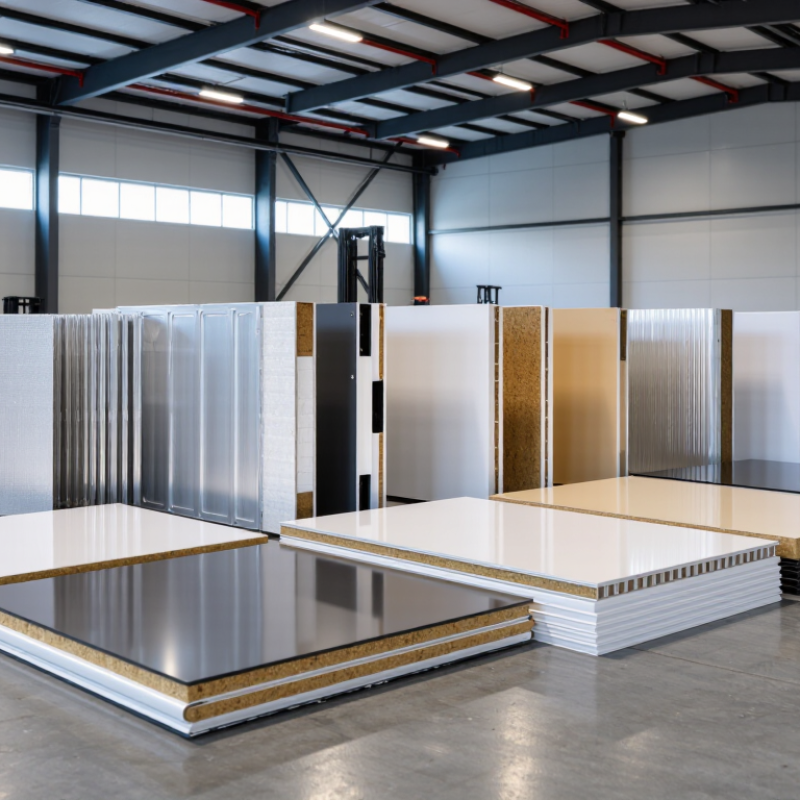
Insulated sheeting panels differ mainly by their core material, facing, and joint design. Common options include EPS, XPS, polyisocyanurate, polyurethane, and mineral wool. EPS usually delivers about R-3.6 to R-4.2 per inch. XPS often reaches around R-5 per inch. Mineral wool provides reliable fire performance and typically offers about R-4 to R-4.4 per inch.
Polyurethane and polyisocyanurate can achieve higher thermal resistance. Some polyisocyanurate products approach R-8 per inch under specific laboratory conditions. That figure needs careful review. Temperature, aging, moisture, and testing standards can change actual performance. A panel rated at R-8 may perform differently in a cold warehouse or humid coastal building.
Panel thickness still matters. A four-inch core cannot match an eight-inch core, even with a higher rated material. Closed-cell cores usually resist moisture better, but damaged edges can weaken that advantage. Mineral wool panels are heavier and may require stronger handling equipment.
During installation, I would inspect every joint, fastener, and cut edge. Small gaps can create cold bridges. They are easy to miss.
Buyers should compare declared R-values, thickness tolerances, fire classifications, water absorption, and thermal aging data. Regional climate should guide the choice. A dry storage building may need a different panel than a refrigerated facility. Published numbers help, but site conditions decide whether the insulation actually works.
PIR panels usually deliver thermal conductivity around 0.022–0.026 W/m·K. They provide strong insulation with thinner cores, useful where interior space matters. PUR panels perform similarly, often near 0.022–0.028 W/m·K. Their practical results depend on foam density, aging, and joint quality. Small gaps can reduce real performance.
EPS panels commonly measure 0.034–0.040 W/m·K and offer a lower-cost option for walls, roofs, and temporary facilities. They are lightweight and easy to cut, but moisture control needs attention. Mineral wool panels typically range from 0.035–0.045 W/m·K. They add valuable fire resistance and sound absorption, especially in industrial or occupied buildings. They are heavier, so framing and lifting plans deserve careful review.
A simple ranking can mislead.
The lowest laboratory value does not always produce the lowest energy bill. Buyers should check declared conductivity, core density, fire classification, facing durability, and tested joint details. Climate also changes the decision: humid coastal sites expose weak seals quickly, while cold regions punish thermal bridges. I have found that installation errors often matter more than a 0.003 W/m·K difference. That is not convenient. Panel thickness, fastener placement, storage conditions, and local code requirements should be verified before purchase. Good documentation matters, particularly when panels cross borders and specifications use different testing standards.
The best insulated sheeting panel depends on three measurable factors: U-value, fire rating, and structural load. U-value shows heat transfer; lower numbers improve thermal efficiency. Fire performance depends on the complete panel system, including facings, joints, and installation. Load capacity changes with thickness, span, support spacing, and wind exposure.
For balanced performance, the ranking is: mineral wool panels, phenolic foam panels, PIR core panels, high-density polyurethane panels, cellular glass panels, XPS panels, EPS panels, vacuum insulation panels, wood-fibre panels, and aerogel composite panels.
Mineral wool usually offers the strongest fire resistance, often reaching A2-s1,d0 in tested assemblies. Phenolic and PIR panels can deliver U-values near 0.15 W/m²K at practical thicknesses, but their fire ratings vary widely. Cellular glass resists moisture and compression well. However, it may add considerable weight. Vacuum panels achieve very low U-values, sometimes below 0.10 W/m²K, but punctures can destroy performance.
Load claims require careful checking. A panel that handles 1.5 kN/m² on a short span may fail on a longer roof span. Do not compare catalog values without testing conditions. I would request declared U-values, fire reports, fastener details, and load tables for the intended climate.
This is where buyers often oversimplify. A lower U-value alone does not guarantee a safer or longer-lasting building. Supplier data also needs independent verification.
Top 10 Insulated Sheeting Panels for Global Buyers
Global Testing Benchmarks: EN 14509, ASTM C578, and ISO 8301
Insulated sheeting panels can look similar, yet their test evidence may differ sharply. EN 14509 evaluates factory-made sandwich panels with metal facings, including thermal performance, mechanical behavior, and reaction to fire. ASTM C578 focuses on rigid cellular polystyrene insulation. It is useful for judging the core, but it does not certify a complete sandwich panel. Buyers should avoid treating these standards as interchangeable.
ISO 8301 uses the heat-flow-meter method to measure thermal resistance. Test results depend on specimen thickness, temperature, moisture, and edge conditions. A declared lambda value alone is not enough. Ask for the test temperature and measurement uncertainty. Small details matter. In practice, I would compare U-values under matching conditions, not attractive catalog figures.
The IEA reports that buildings consume about 30% of global final energy and produce roughly 26% of energy-related emissions. The 2023 UNEP/GlobalABC report places building operations and construction at about 34% of global energy demand and 37% of energy-related emissions. These figures explain why panel selection deserves technical discipline. Check EN 14509 documentation for finished-panel performance, ASTM C578 data for polystyrene cores, and ISO 8301 records for thermal resistance. A pass on paper can still disappoint on site. Installation gaps, wet insulation, and damaged joints remain difficult variables.
| Rank | Generic Panel Configuration | Typical Core Material | Typical Core Density | Common Panel Thickness | Typical Thermal Conductivity λD | Approx. R-Value at 100 mm | Typical Applications | EN 14509 Relevance | ASTM C578 Reference | ISO 8301 Use |
|---|---|---|---|---|---|---|---|---|---|---|
| 1 | Metal-Faced PIR Sandwich Panel | Polyisocyanurate foam | 30–40 kg/m³ | 60–200 mm | 0.021–0.024 W/(m·K) | 4.17–4.76 m²·K/W | Cold rooms, industrial walls, roofs and temperature-controlled buildings | Applicable when designed and tested as a complete sandwich panel system | Not generally classified under ASTM C578; product-specific insulation standards may apply | Suitable for measuring thermal resistance under a guarded heat-flow-meter method |
| 2 | Metal-Faced PUR Sandwich Panel | Polyurethane foam | 35–45 kg/m³ | 40–200 mm | 0.022–0.026 W/(m·K) | 3.85–4.55 m²·K/W | Commercial façades, warehouses, refrigerated enclosures and roofs | Applicable to the complete profiled or flat sandwich panel assembly | Not generally classified under ASTM C578 | Can be used to determine thermal resistance of the core or panel assembly, subject to test configuration |
| 3 | Metal-Faced Mineral Wool Sandwich Panel | Stone wool or mineral wool lamellas | 90–150 kg/m³ | 80–240 mm | 0.035–0.045 W/(m·K) | 2.22–2.86 m²·K/W | Fire-sensitive industrial buildings, façades, partitions and roofs | Commonly assessed under EN 14509 for mechanical, thermal and fire performance | ASTM C578 does not normally classify mineral wool products | Applicable for laboratory measurement of thermal resistance |
| 4 | Metal-Faced EPS Sandwich Panel | Expanded polystyrene | 15–25 kg/m³ | 50–200 mm | 0.034–0.040 W/(m·K) | 2.50–2.94 m²·K/W | General-purpose walls, agricultural buildings, warehouses and temporary structures | Applicable when the full panel construction meets the relevant EN 14509 requirements | May correspond to ASTM C578 Type I for molded expanded polystyrene, subject to density and product testing | Applicable for measuring thermal resistance under controlled laboratory conditions |
| 5 | Metal-Faced XPS Sandwich Panel | Extruded polystyrene | 28–40 kg/m³ | 50–150 mm | 0.028–0.034 W/(m·K) | 2.94–3.57 m²·K/W | Moisture-exposed walls, below-grade applications and high-compression panels | Applicable only when the complete panel system is engineered and tested to EN 14509 | May correspond to ASTM C578 Type IV or another applicable XPS type, depending on properties | Applicable for thermal-resistance measurement; edge effects and facings must be considered |
| 6 | Metal-Faced Phenolic Foam Panel | Phenolic foam | 35–50 kg/m³ | 50–150 mm | 0.019–0.024 W/(m·K) | 4.17–5.26 m²·K/W | High-performance wall and roof systems where low thermal conductivity is important | Potentially applicable as a complete tested sandwich panel; classification depends on the system | Not generally classified under ASTM C578 | Useful for measuring the thermal resistance of the foam or finished panel |
| 7 | Metal-Faced Glass Wool Panel | Glass mineral wool | 45–80 kg/m³ | 80–240 mm | 0.035–0.042 W/(m·K) | 2.38–2.86 m²·K/W | Acoustic partitions, façades, roofs and non-refrigerated industrial buildings | Applicable when the panel construction is covered by the EN 14509 product scope | ASTM C578 does not normally classify glass wool products | Applicable to laboratory measurement of thermal resistance and thermal conductivity |
| 8 | Metal-Faced Wood-Fiber Insulation Panel | Rigid wood-fiber board | 110–180 kg/m³ | 60–200 mm | 0.038–0.050 W/(m·K) | 2.00–2.63 m²·K/W | Low-carbon building envelopes, façades and ventilated roof systems | Requires verification that the complete panel configuration falls within EN 14509 | Not generally classified under ASTM C578 | Applicable for determining thermal resistance, including moisture and density conditions specified for testing |
| 9 | Metal-Faced Cork Insulation Panel | Expanded cork granules | 100–เหม150 kg/m³ | 60–200 mm | 0.037–0.045 W/(m·K) | 2.22–2.70 m²·K/W | Bio-based building envelopes, modular construction and renovation projects | Use requires confirmation of EN 14509 applicability for the specific panel assembly | Not generally classified under ASTM C578 | Applicable for laboratory determination of thermal resistance |
| 10 | Vacuum-Insulated Panel Cassette | Microporous core enclosed in a gas-tight barrier film | Typically 150–250 kg/m³ equivalent core system | 20–50 mm | 0.005–0.012 W/(m·K) | 8.33–20.00 m²·K/W | Space-constrained cold rooms, high-performance façades and specialty retrofit systems | Usually outside the conventional EN 14509 sandwich-panel scope unless specially configured and assessed | Not generally classified under ASTM C578 | Applicable, but panel joints, thermal bridges, aging and envelope integrity must be included in the test design |
Top 10 Insulated Sheeting Panels for Global Buyers
A useful buyer matrix should compare 0.4–1.0 mm facings, not panel price alone. Thinner facings reduce weight and handling costs. They can dent more easily during transport and installation. Thicker steel improves impact resistance, edge stability, and fastener performance. However, it may increase material cost and embodied carbon. The International Energy Agency reports that buildings used about 30% of global final energy in 2022. Better thermal continuity therefore matters beyond the purchase invoice. Check declared U-values under EN 14509 conditions, rather than relying on marketing estimates.
Service life depends on climate, coating, drainage, and maintenance. Coastal salt, high humidity, ultraviolet exposure, and freeze-thaw cycles can shorten performance. ISO 15686 recommends evaluating service life through documented environmental conditions and replacement assumptions. A credible supplier should provide coating data, corrosion testing, fire performance, and an environmental product declaration where available. Reported lifespans often look precise. Real sites are messier. A poorly sealed joint can undermine an excellent core.
Tips: Score each of the ten panels for facing thickness, thermal performance, warranty evidence, repairability, and delivered cost. Separate factory cost from lifetime cost. Request samples with actual corner details. Inspect cut edges, seals, and screw zones. For tropical projects, test condensation risk. For cold regions, review thermal bridging at joints. Do not treat the cheapest panel as the best value. Your matrix should include uncertainty, because climate exposure and installation quality are rarely identical.
Buyer Selection Matrix: 0.4–1.0 mm Facings, Service Life, Cost, and Climate
The indicative selection score combines expected service life, facing thickness, relative cost, fire and moisture performance, and suitability across hot, cold, humid, and high-wind climates. Values represent generic panel configurations rather than company or brand products. Hover over each bar to view the underlying buyer-selection data. Final specifications should be verified against local building codes and project conditions.
EN 14509 evaluates complete factory-made sandwich panels with metal facings. It covers thermal performance, mechanical behavior, and reaction to fire. The full assembly matters here.
No. ASTM C578 mainly evaluates rigid cellular polystyrene insulation cores. It does not certify the complete sandwich panel. Treating them as identical can create confusion.
ISO 8301 measures thermal resistance using the heat-flow-meter method. Results depend on thickness, temperature, moisture, and edge conditions. Small details matter.
A lambda value alone may hide test conditions and measurement uncertainty. Ask for test temperature, specimen thickness, moisture condition, and uncertainty. Compare U-values under matching conditions.
Compare facings between 0.4 and 1.0 millimeters. Thinner facings reduce weight and handling costs. They may dent more easily during transport. Thicker steel usually improves impact resistance and fastener stability.
Climate, coating quality, drainage, sealing, and maintenance all influence service life. Coastal salt and high humidity can accelerate deterioration. Ultraviolet exposure and freeze-thaw cycles may also reduce performance. Reported lifespans can look too precise.
Inspect corner joints, cut edges, seals, and screw zones. Look for exposed cores, weak edges, or uneven sealing. A small joint gap can become a major thermal problem. It happens.
Score panels for facing thickness, thermal performance, repairability, warranty evidence, and delivered cost. Separate factory price from lifetime cost. Include installation quality and climate exposure in the calculation. The cheapest option may not be the best value.
This guide compares the top 10 Insulated Sheeting Panels for international construction and industrial buyers, focusing on thermal efficiency, fire performance, structural strength, and long-term value. It explains the core panel types—PIR, PUR, EPS, and mineral wool—whose thermal conductivities typically range from 0.022 to 0.045 W/m·K, with insulation performance reaching approximately R-8 per inch in suitable designs. Each panel is assessed by U-value, fire rating, load capacity, and practical suitability for walls, roofs, cold rooms, and controlled environments.
The guide also introduces key testing benchmarks, including EN 14509, ASTM C578, and ISO 8301, helping buyers compare technical data more consistently across regions. A selection matrix considers facing thicknesses from 0.4 to 1.0 mm, expected service life, installation conditions, total cost, and climate exposure. By balancing performance, durability, compliance, and budget, buyers can identify the most appropriate panel solution for demanding projects in different markets.
JUTAO NEW MATERIAL